
 Kara Davidson
When people think about student safety, the focus often falls on classrooms, hallways, and playgrounds. Yet one critical area frequently overlooked is the school parking lot. Every day, hundreds of cars, buses, and pedestrians converge in these confined spaces during drop-off and pick-up times. The result is often congestion, confusion, and, in too many cases, potential hazards for students, staff, and families.
The Reality on the Ground
A typical school day starts and ends with a flurry of movement. Parents pull in to drop off children, buses arrive on schedule, staff members try to find parking, and students navigate their way on foot or by bike. All of this occurs within a compressed timeframe—often just 30 to 60 minutes—turning parking lots into chaotic zones where the risk of accidents increases dramatically.
Common issues contributing to this unsafe environment include:
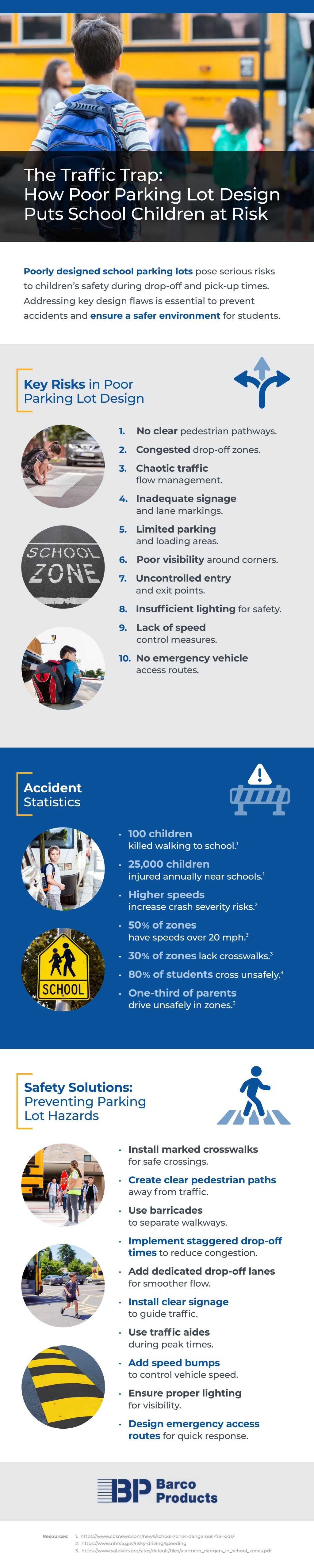
- Double-parking and illegal stops, which force students to cross active lanes of traffic.
- Minimal separation between vehicles and pedestrians, leaving drivers with little time to react.
- Poor signage or faded lane markings, resulting in unclear directions and unpredictable driving behavior.
- Inadequate crosswalks or lack of crossing guards, particularly in large school campuses with multiple entry points.
- Speeding vehicles, often driven by parents running late or unfamiliar with school protocols.
These problems are not isolated incidents—they are systemic and require proactive solutions to prevent accidents and injuries.
Data That Can’t Be Ignored
National safety statistics reveal that hundreds of children are injured each year in school-related traffic incidents, many of which happen in or near parking lots. Alarmingly, a significant number of school zones lack basic safety features such as well-marked crosswalks, visible speed limit signs, or physical barriers separating pedestrians from traffic.
Surveys also show that parents themselves are often responsible for traffic violations in school zones, underscoring the need for increased education and stricter enforcement during peak hours.
Simple Fixes With Big Impact
The good news is that improving parking lot safety does not always require large-scale renovations. Small, strategic changes can make a noticeable difference. These include:
- Adding clear directional arrows, painted lanes, and reflective signs to guide drivers effectively.
- Installing physical barriers or bollards to create safe walking paths separate from drive lanes.
- Designating specific waiting zones to keep parked vehicles out of traffic flow.
- Employing crossing guards or trained volunteers to assist with pedestrian movement during busy periods.
- Using speed cushions or rumble strips to encourage slower driving in high-traffic areas.
Technology can also enhance safety. Surveillance cameras and automated signage can monitor driver behavior and reinforce rules in real time.
A Safer Environment Starts Outside the Classroom
Protecting students begins long before they enter the building. Parking lots deserve the same level of planning and care as other parts of a school’s safety infrastructure. From equipment and signage to design and protocols, these spaces should not be treated as an afterthought.